
In the wake of the tragic death of architect Erica Tishman, who was killed by falling debris from a brick tower in midtown Manhattan in December 2019 , the New York Department of Buildings (DOB) amended its rules governing exterior wall inspections and repairs. The new rules went into effect on February 20, 2020. Known as the Local Law 11 inspections, the Façade Inspection & Safety Program (FISP) has undergone extensive amendments in an effort to address the increasing number of dangerous façade conditions including corroded masonry and fractured terra cotta which in addition to causing structural problems, can loosen and fall to the ground causing bodily harm or property damage.

This issue is a growing concern. During the past six years, more than 4,790 Environmental Control Board violations related to facades were issued of which more than half remain active.[i] The DOB reported more than 22,000 violations related to facades since 2014.[ii]
Continue Reading NYC Amends Its Façade Inspection and Safety Program to Push Building Owners into Action
As the Coronavirus spreads across the globe, its impact continues to disrupt many industries, including construction.  Over the last twenty years, the construction industry in the United States has substantially increased its reliance on China as a supplier for all types of construction materials including electrical and lighting equipment, elevators and component parts, plumbing fittings

As all members of the construction industry know, the prevention of the occurrence of work-related injuries and illnesses is a constant concern, and one that can have serious implications for the various contractual relationships on a construction project. To address these concerns, construction industry employers often implement incentive programs to award both the reporting of injuries or illnesses and the lack of occurrence of reportable incidents. In addition, both before and after injuries or illnesses occur, many employers have drug testing policies which are implemented with the goals of preventing and/or discovering the causes of work-related injuries and illnesses.
Continue Reading OSHA Clarifies Position On Anti-Retaliation Rule

As we have written about previously, this past Spring the New York State Legislature and New York City Council adopted broad new requirements to combat workplace gender-based harassment. Adopted in April and May by the New York General Assembly and New York City Council, respectively, the sweeping sexual harassment laws represent a renewed and comprehensive program to end workplace sexual harassment.

In addition, the New York City Commission on Human Rights published a mandated sexual harassment poster, which is now required to be posted conspicuously, both in English and Spanish, in covered workplaces.
Continue Reading New York Requires Sexual Harassment Policies in Compliance with New Requirements to Be Distributed by Tuesday, October 9, 2018 (But Deadline Extended for Newly Mandated Training)

It’s been said that as California goes, so goes the nation. If so, general contractors throughout the country may soon be taking on more responsibility for the unpaid wages of the workers on their construction projects than they might have expected. As of January 1, 2018, Assembly Bill 1701 makes general contractors liable for the unpaid wages of any employee who furnishes labor to or through the general contractor in furtherance of the prime contract; no matter the tier.

A.B. 1701 amended Section 218.7 of the California Labor Code so that general contractors on private construction projects “assume, and [are] liable for any debt” of a subcontractor of any tier for unpaid wages, fringe benefits or other employee contributions. The driving force behind the legislation was the labor unions. The legislation does not provide for a private right of action to the unpaid employees but instead permits the Commissioner of Labor to file suit on behalf of an unpaid employee(s) and also allows labor unions to sue for unpaid wages or benefits. There is a one year statute of limitations for such claims.
Continue Reading California and Maryland Have Enacted Legislation Essentially Making The General Contractor the Guarantor for All Wages on the Project – Should Sureties Be Concerned?

For years, general contractors and trade contractors have faced very strict “no damages for delay” clauses on New York State construction projects. The tides are changing.  If signed into law, S. R. 06686, Reg. Sess. 2017-2018 (NY 2017) will require public entities to allow contractors, subcontractors and suppliers to recover for costs associated with project delays to the extent the delays were caused by the entity’s actions or inactions. Public entities would include, without limitation, any state agency, department, board, bureau, municipal corporation, school district or any instrumentality or public subdivision of the State of New York.
Continue Reading Will Strict “No Damages for Delay” Clauses Be Outlawed on New York Public Construction Projects? Stay tuned.

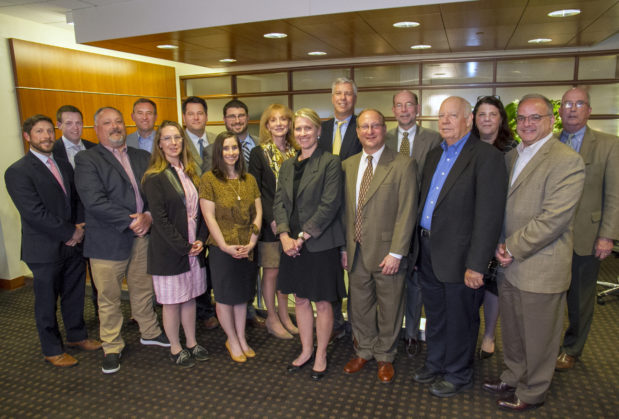
Building upon the success of last year’s event, on May 31, 2018 Robinson+Cole’s Construction Group led the Second Construction Industry Roundtable Discussion at its Hartford office. With a variety of representatives from major Connecticut construction industry organizations and other industry stakeholders in attendance, the participants discussed issues affecting the construction industry in 2018 and beyond.

With 2018 being an election year in Connecticut, the discussion began with a question posed to all attendees about anticipated outcomes and impact of the gubernatorial election in November. All agreed that, while the result of the election remains difficult to predict, the next governor will inevitably be required to address continued challenges with the state’s economy as a whole and the burden of state government personnel costs specifically. Several expressed concern as to the State’s perceived unfavorable climate for doing business. As an industry particularly susceptible to influence by the current economic climate, it was agreed that good news for the economy and business growth would certainly be good news for the construction sector.
Continue Reading Summary of the Second Construction Industry Roundtable Discussion

Our readers may recall that Public Act No. 15-28 was signed by the Governor back in 2015, subjecting the State of Connecticut and its political subdivisions to a statute of limitations for asserting actions and claims arising out of “construction-related work.” The law became effective as of October 1, 2017. “Construction-related work” is defined in the Act to include the design, construction, construction management, planning, construction administration, surveying, supervision, inspection or observation of construction of improvements to real property. Notably, it applies not only to the State, but also its subdivisions such as cities, towns, and other entities like school districts.

The limitations period set forth in the Act is 10 years from the date of substantial completion of a given improvement. The 10 year limitations period applies going forward to improvements to real property substantially completed on or after October 1, 2017. For improvements substantially completed before October 1, the limitations period runs to October 1, 2027. Prior to the Act, the State and its political subdivisions were generally not subject to any statutes of limitations for such claims due to the legal doctrine of nullum tempus occurrit regi, which provides that a state is not subject to statutes of limitations unless it specifically consents to be. Literally translated, it means that “no time runs against the king.”
Continue Reading Tic Toc Tic Toc: The Clock Is Running on Construction and Design Claims by the State of Connecticut Beginning October 1, 2017

On August 30, 2017 Robinson+Cole’s Construction Practice Group held its annual Retreat at the newly completed Dunkin’ Donuts Park in Hartford. The Retreat featured an Industry Leaders Roundtable discussion session with representatives from many  of the major Connecticut construction industry organizations. The discussion was moderated by Construction Group Chair Greg Faulkner and led to a lively discussion on various issues affecting the construction industry. Here are some of the highlights:

The first topic of discussion focused on what attendees viewed as the most significant challenges facing design and construction service providers in the immediate future. All in attendance agreed that the shortage of young professionals and tradespeople embarking on careers in the construction and design industries was an issue of serious concern. It was pointed out that Connecticut is unique among many of our neighboring states in that it provides options to young people considering a career in the construction industry through trade schools, which feature an academic curriculum in addition to skills education, and the fact that public high schools are increasingly adding trade-skills-based education back into their regular curricula. This was viewed as good news by all. On a related note, those in attendance reported positively on the increased presence of women in the construction and design industries, particularly the trend of more women entering the industries as young professionals and advancing in seniority to managerial roles.
Continue Reading Robinson+Cole Hosts Industry Leaders Roundtable Discussion

In negotiating construction contracts, the parties may ignore or give little attention to the project’s insurance requirements.  Insurance provisions are oftentimes left untouched on the standard industry forms.  One typically misunderstood type of project insurance is builders’ risk, also sometimes referred to as an “all risk” policy, or BRI.  Builders’ risk insurance is a property